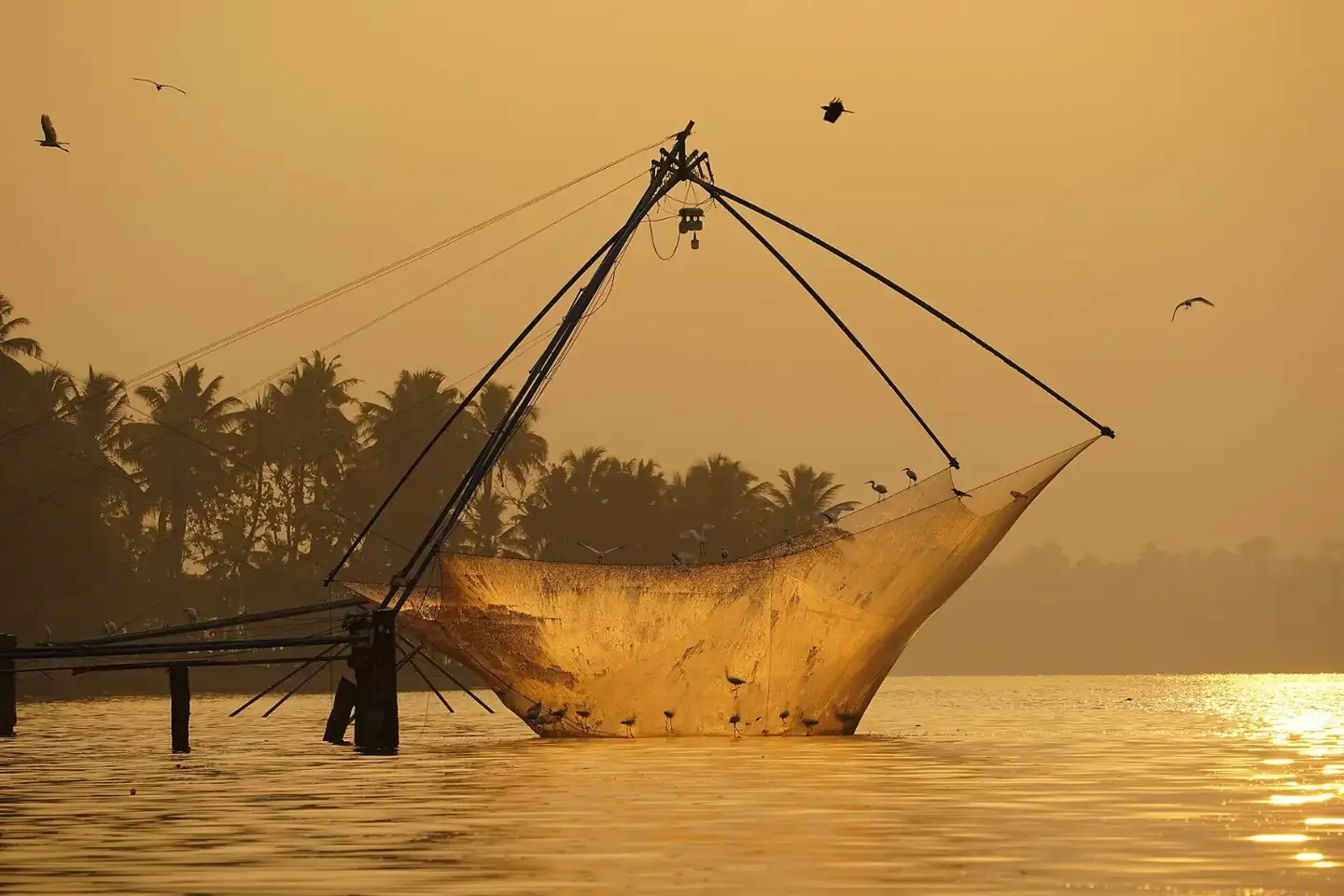
- Local name
- Cheena vala
- Entry fee
- Free
- Best time of day
- Early morning and late afternoon
- Nearest airport
- Cochin International Airport, about 40 km
- Nearest railway station
- Ernakulam Junction / Ernakulam Town
How the nets work
Each installation is a large wooden frame, around 20 metres across and roughly 10 metres high, fixed on the shore. A long arm reaches over the water and carries a wide net; on the land side, ropes hang with heavy stones that balance the load. The balance is so fine that one person stepping out along the central beam is enough to tip the net down into the water.
The net stays under for only a few minutes before the crew, usually about half a dozen people, haul on the ropes to lift it. As it rises, the stones settle one by one onto a platform, steadying the frame. Because the nets work only in a certain depth of water, their use depends on the tide.
Origins
These nets are widely believed to have reached Kerala through early trade with China, which is where the local name comes from. Today they survive mainly around Kochi and the nearby backwaters, and several along the Fort Kochi beach are kept working, partly for the benefit of tourists.
Tips for your visit
- Entry is free, and you can photograph and film freely
- Come early in the morning or late in the afternoon, when the nets are most active
- Stalls nearby sell the fresh catch, and small eateries will cook it for you
- Combine the walk with St. Francis Church, the Dutch cemetery and Fort Kochi's old streets
How to reach
Cochin International Airport at Nedumbassery is roughly 40 km away. Ernakulam Junction and Ernakulam Town are the main railway stations, from where taxis, autos and buses reach Fort Kochi. A ferry from the Ernakulam boat jetty is a cheap and scenic alternative.
Also nearby
Plan it with us
Tell us your dates and who is travelling. We will build the route, book the car, driver and hotels, and send you a clear quote.
