- Significance
- First of the twelve Jyotirlingas
- Present temple completed
- 1951
- Architecture
- Chaulukya (Maru-Gurjara) style
- Nearest railway station
- Somnath (SMNH)
- Nearest airport
- Diu, about 63 km
- Ideal time needed
- Half a day
History and legend
The shrine was attacked and destroyed several times over the centuries and rebuilt on each occasion by devotees and rulers. The present structure was raised after independence with strong backing from Sardar Vallabhbhai Patel and was completed and consecrated in May 1951.
Legend says Soma, the Moon god, lost his glow because of a curse and regained it by bathing here in the Saraswati. The waxing and waning of the moon, and the tides along this coast, are linked to that story. The name Prabhas refers to radiance.
Architecture
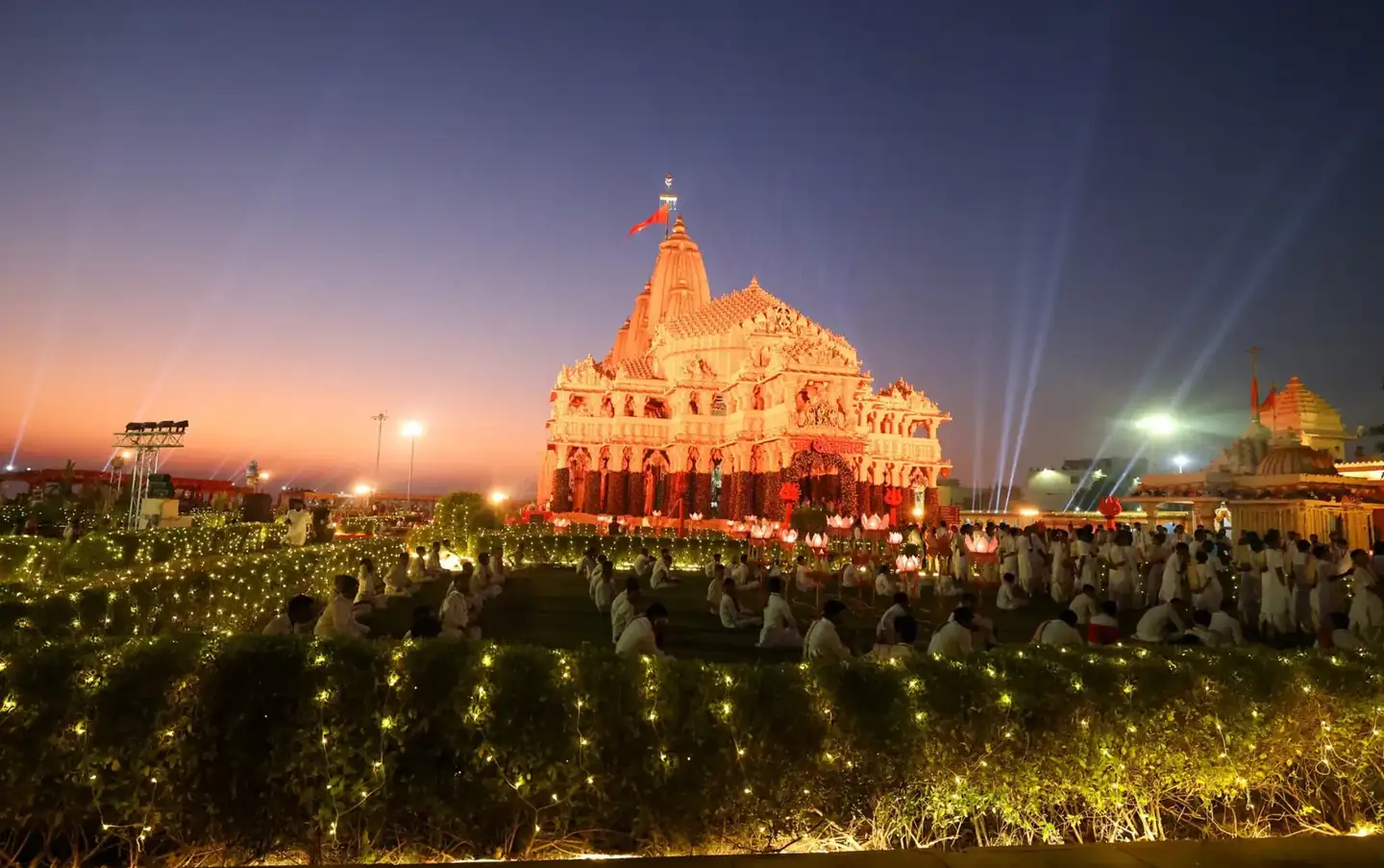
The temple follows the Chaulukya or Maru-Gurjara style, with influences from Saurashtra and Mewar. It is built of yellow sandstone and covered with carvings of gods, myths and celestial figures. The sanctum holding the Jyotirlinga is designed to catch direct sunlight.
On the sea wall stands the Baan Stambh, an arrow pillar whose inscription notes that there is no land in a straight line between this point and the South Pole.
Triveni Sangam
Close to the temple, three rivers, the Hiran, the Kapila and the Saraswati, meet at the Triveni Sangam, a bathing spot that pilgrims visit as part of the Somnath darshan.
How to reach
Somnath has its own railway station (code SMNH), and Veraval station next door has wider connections. Scheduled flights to Somnath itself are few; Diu Airport, around 63 km away, is the nearest, and Porbandar is another option. The Somnath bus station links the town by road to the rest of Gujarat.
Allow half a day for darshan, the sea front and the Sangam. We can plan a Saurashtra route covering Somnath, Dwarka and Porbandar.
Also nearby
Plan it with us
Tell us your dates and who is travelling. We will build the route, book the car, driver and hotels, and send you a clear quote.
