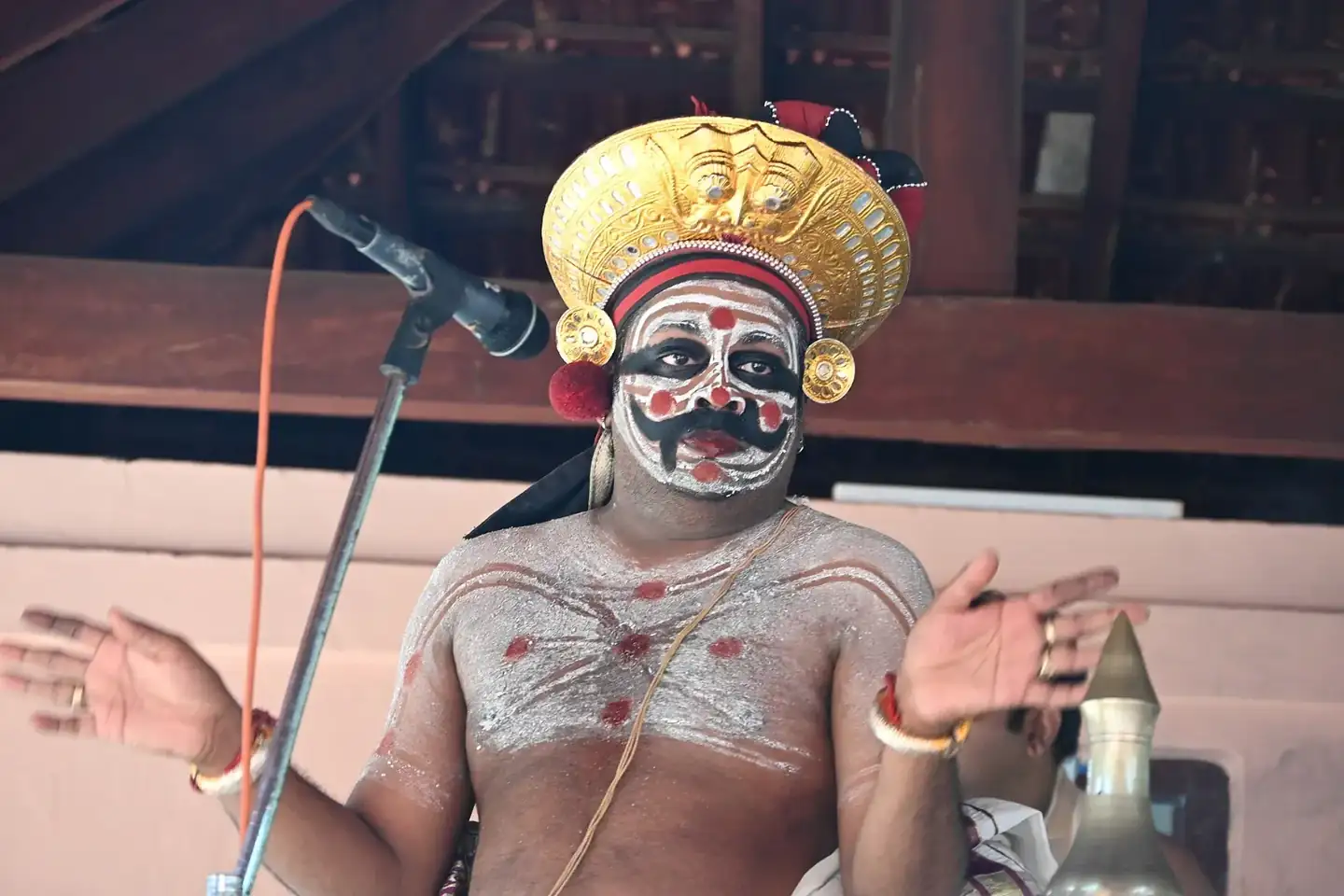
- Performers
- Traditionally men of the Chakyar community
- Instrument
- Mizhavu
- Language
- Sanskrit and Malayalam
- Venue
- Koothambalam (temple theatre)
Origins
The art takes its name from the Chakyar community, whose men traditionally held the right to perform it. It was staged as an offering inside the koothambalam, the dedicated theatre hall attached to major Kerala temples. Because the right to perform stayed within one community for centuries, the gestures, text and structure were passed down with great care.
A Chakyar is expected to be a scholar as much as a performer, with a sound knowledge of Sanskrit, Malayalam, mythology and philosophy.
How it is performed
The performer is accompanied by the mizhavu, a large copper pot drum played by men of the Nambiar community by tradition, which marks the rhythm and highlights key moments.
The look is simple and symbolic rather than grand:
- Face marked with rice paste, turmeric and black powder
- An ornament in one ear
- A betel leaf carried in one hand
- White dhoti and the sacred thread
Satire and social comment
While telling an old story, the Chakyar steps aside to comment on modern life: social wrongs, politics and everyday hypocrisy. By custom, people in the audience could not answer back, and even kings are said to have been careful around a sharp-tongued Chakyar. This mix of devotion and criticism has kept the form lively and relevant.
Where to see it
Performances still take place in koothambalams during temple festivals, although these spaces may be open only to Hindus. Chakyar Koothu is also presented at cultural festivals and heritage venues across Kerala, which are open to all visitors. We can help you find performance dates while planning your Kerala trip.
Plan it with us
Tell us your dates and who is travelling. We will build the route, book the car, driver and hotels, and send you a clear quote.
